
Health Hub · Skin cancer
Two in three Australians will be diagnosed with some form of skin cancer before the age of 70, according to Cancer Council Australia, and Queensland carries the highest rates in the world. Yet skin cancer is not one disease. The three main types behave differently, look different, and are managed differently. Knowing the basics helps you understand what your GP is looking for at a skin check, and why some spots matter more than others.
Basal cell carcinoma (BCC)
BCC is the most common form of skin cancer in Australia. It develops in the basal cells of the skin and most often appears on areas that get regular sun: the face, ears, neck, shoulders and back.
What it can look like: a pearly or pale lump, a scaly dry patch that is pink or red, or a sore that seems to heal and then breaks down again. BCCs usually grow slowly and very rarely spread to other parts of the body, but they can grow deeper into the skin if left untreated, which makes removal more involved than it needed to be.
Squamous cell carcinoma (SCC)
SCC is the second most common type. It arises in the squamous cells of the upper skin layers and tends to appear on sun-exposed skin: the head, neck, hands, forearms and lower legs.
What it can look like: a thickened, red, scaly spot, a rapidly growing lump, or a sore that has not healed within a few weeks. Some SCCs are tender to touch. SCCs can grow more quickly than BCCs and, in a small proportion of cases, can spread to other parts of the body, which is why a changing or persistent sore is worth showing your doctor promptly.
Melanoma
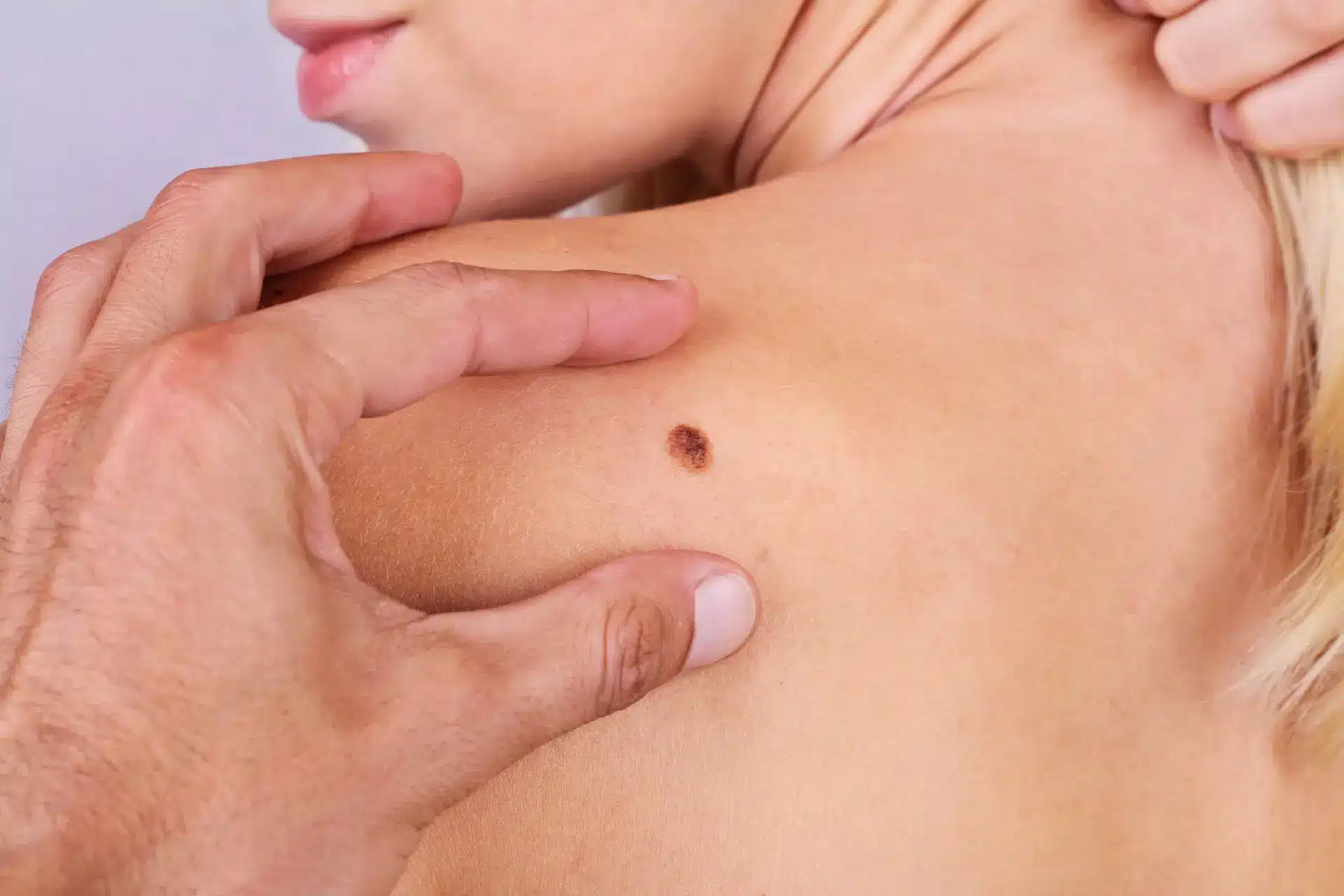
Melanoma is less common than BCC and SCC but is the most serious of the three, because it has a greater tendency to spread beyond the skin. It develops in the melanocytes, the cells that give skin its pigment, and can appear anywhere on the body, including areas that rarely see the sun. It can arise in an existing mole or as a new spot.
What it can look like: a new spot, or an existing mole that changes in size, shape or colour. The ABCDE guide (Asymmetry, Border, Colour, Diameter, Evolving) is a practical prompt for what to watch for; our guide to checking your own skin covers it step by step. Not every melanoma follows the rules, so any spot that stands out from your others, sometimes called an ugly duckling, deserves attention.


What about sunspots and other lumps?
Not everything on Queensland skin is cancer. Actinic keratoses (sunspots) are rough, scaly patches caused by sun damage; a small proportion can progress to SCC over time, so your GP may monitor or treat them, often with cryotherapy. Seborrhoeic keratoses, skin tags and harmless moles are common too. The point of a professional check is telling these apart, which is not something to attempt from a search engine.
How skin cancers are diagnosed and treated

Diagnosis starts with an examination using a dermatoscope (here is how dermoscopy works). If a spot looks suspicious, the next step is usually a biopsy, where a small sample is sent to a pathology laboratory; our guide on what happens after a skin biopsy explains the process. Depending on the result, treatment may involve surgical excision, cryotherapy, prescription creams for some superficial cancers, or referral where specialist care is appropriate. At Main Street Medical Centre, skin cancer excisions are performed by our GPs on site, usually without a hospital visit.
Frequently asked questions
Which type of skin cancer is most common?
Do all skin cancers come from moles?
How quickly should I act on a changing spot?
Can a GP manage skin cancer, or do I need a referral first?
Worried about a spot, or overdue for a check?
A full body skin check takes a small part of your day and the consultation is bulk billed for eligible Medicare card holders. You will find us at 71 Main Street, Pialba.
This article is general information and is not a substitute for individual medical advice.
Last reviewed September 2026