
Skin checks and care in Pialba
Skin cancer clinic
in Hervey Bay.
A full skin check, a spot you’re concerned about, or advice on your next step. Our GPs provide skin assessments and treatment at the practice.
No referral needed · Online booking with AutoMed


Bulk Billed Skin Checks
Skin check consultations are bulk billed for eligible Medicare card holders. Eligibility applies. Non-Medicare services may incur a fee. Our GPs use dermoscopy and, where appropriate, DermEngine digital imaging to assess doubtful or equivocal lesions and monitor changes over time.
Add OptimaScan 3D mole mapping (total body photography) to your skin check for $49, until 31 December 2026, then $99 from 1 January 2027. The scan is optional; your GP can advise whether it is suitable for you. The photography is a private fee, with no Medicare rebate and no GST. Book a skin check with OptimaScan or explore OptimaScan or read what to expect at your OptimaScan appointment.
Surgical procedures (biopsies, excisions) and OptimaScan 3D Total Body Photography may incur separate fees, and Medicare rebates may apply. View fees or speak with reception for an estimate.
When booking, select Spot Check or Full Body Skin Check as your appointment type.
Why choose our skin cancer clinic in Hervey Bay
As a skin cancer clinic in Hervey Bay operating inside a full general practice, we bulk bill the consultation, perform biopsies and surgery on site in Pialba. For patients with many moles, OptimaScan 3D mole mapping is available on site.
Our Skin Cancer Services
When you book a skin cancer check at our Pialba practice, we can arrange assessment and many procedures on-site in our purpose-built procedure rooms. Our services include full body skin examinations, focused spot checks, digital dermoscopy imaging, total body photography, and surgical treatment where required. If specialist care is needed, your GP will discuss referral options with you.

Full Body Skin Checks
Comprehensive head-to-toe clinical examination using high-resolution dermoscopy. During a full body skin check, our GPs assess every mole and lesion to identify early warning signs of skin cancer.
Explore full skin checks →
Focused Spot Checks
Rapid 10-minute appointment for patients concerned about up to 4 individual moles or lesions. Ideal when you have noticed a changing or suspicious spot that needs prompt evaluation.
Explore spot checks →
Biopsies & Excisions
Surgical removal of suspicious lesions performed on-site in our purpose-built surgery rooms. Our integrated pathway means your assessment, procedure and follow-up are all managed from one practice.
Learn About Skin Surgery →
Cyst & Tag Removal
Clinical removal of benign lumps, bumps and skin tags. Our doctors prioritise patient comfort and minimal scarring using appropriate techniques for each individual case.
Explore Minor Procedures →
Cryotherapy
Precision liquid nitrogen treatment for solar keratoses (sun spots), warts and other minor skin lesions. A non-invasive option designed to address abnormal cells before they progress.
Learn About Cryotherapy →
Skin Cancer Surgery
Skin cancers and suspicious spots removed on-site in our dedicated surgery rooms.
Explore skin cancer surgery →
Mole Mapping (OptimaScan)
Optional photography alongside your GP skin check: a baseline to compare over time. $49 introductory fee until 31 December 2026.
Explore mole mapping →
Digital Lesion Monitoring
Using DermEngine clinical imaging, Dr Nadeesh Seneviratne and Dr Moe Thu photograph doubtful or equivocal lesions through a dermatoscope and save them to the body location where each lesion was found. AI-assisted analysis helps assess the images, and your GP can track changes over time at follow-up appointments. Bulk billed for eligible Medicare card holders.
Learn About Digital Monitoring →Who Should Book a Skin Cancer Check — and How Often?
How often you need a skin cancer check depends on your personal risk factors. When considering a skin cancer check, patients should think about their sun exposure history, skin type and family history. Many Queenslanders benefit from routine skin checks, particularly those who spend a lot of time outdoors or have a history of sunburn.
You may benefit from regular skin checks if you:
- Have had a previous skin cancer or melanoma
- Have a family history of melanoma
- Have fair skin, freckles, or a tendency to burn
- Have many moles, atypical moles, or changing lesions
- Work outdoors or have high lifetime sun exposure
- Are immunosuppressed (for example, certain medications or medical conditions)
- Live in a high-UV region such as the Fraser Coast
If you're unsure which appointment to book, our triage tool below can help guide you, or you can call reception on (07) 4325 4000 for assistance. Patients with a history of skin cancer or lesions requiring surveillance may benefit from digital dermoscopy monitoring or OptimaScan 3D Total Body Photography to track changes over time.
High-Risk Groups on the Fraser Coast
The Fraser Coast lifestyle means more time outdoors — which also means increased cumulative UV exposure over a lifetime. A regular skin check is particularly important for people in high-risk occupations and circumstances.
Are You in a Higher-Risk Group?
The following groups may benefit from more frequent skin checks and ongoing monitoring. If any of these apply to you, speak with your GP about an appropriate screening schedule.
This tool provides general guidance only and does not replace professional medical advice. If symptoms are severe or you feel very unwell, call 000 or go to the nearest Emergency Department. If a lesion is rapidly changing, bleeding, crusting, painful or not healing, please book the earliest available appointment.
Why Book a Skin Cancer Check in Hervey Bay?
Living on the Fraser Coast offers a beautiful outdoor lifestyle, but it also means increased exposure to harmful UV radiation throughout the year. According to the Bureau of Meteorology, the UV Index in Queensland can reach levels of 11 or higher during summer — classified as “extreme” — making a regular skin cancer check important for Hervey Bay residents.
When detected early, treatment options are often simpler. According to Cancer Australia, the five-year survival rate for melanoma is 94% overall in Australia. The challenge is that dangerous changes often occur beneath the skin surface before becoming visible to the untrained eye. During a skin check, your GP uses dermoscopy — a magnification and lighting technique — to identify structural changes indicating potential malignancy well before they become obvious. If you have 1–4 specific spots of concern, a focused spot check may be appropriate.
For patients with a higher risk profile — such as those with many moles, a family history of melanoma, or previous skin cancer — digital dermoscopy monitoring provides an objective way to track changes between appointments. Our practice also offers OptimaScan 3D Total Body Photography for high-resolution full-body skin mapping. These tools are particularly valuable for people in our region where lifetime UV exposure tends to be high.
What to Expect at Your Appointment
When you attend a skin cancer check at our Pialba practice, your GP performs a clinical examination using dermoscopy. During each appointment, your skin is assessed for changes that may indicate early skin cancer or other conditions that require monitoring or treatment.
How long does a skin check take?
- Focused spot check: approximately 10 minutes, designed for up to 4 specific spots you're concerned about.
- Full body skin examination: typically 20–30 minutes for a thorough head-to-toe assessment. Appointment length may vary depending on your skin history, the number of lesions to assess, and whether dermoscopic imaging is required.
What we examine
During a full body skin check, your GP will assess commonly missed areas such as the scalp, ears, back, backs of the legs, soles of the feet and nails. If you have specific concerns (for example, a new or changing spot), please point these out at the start of your appointment.
Privacy and comfort
Your comfort and privacy are important during any skin examination. A gown is provided for full-body checks and you can request that sensitive areas are examined last or only if clinically necessary. If you'd prefer a female GP for a full-body examination, you can book with one of our female doctors.
Dermoscopy and digital imaging
During your appointment, we use dermoscopy (special magnification and lighting) to examine the structure of moles and lesions below the surface. This technique allows our GPs to detect patterns that are not visible to the naked eye. For patients who need closer surveillance, Dr Nadeesh Seneviratne and Dr Moe Thu also use DermEngine digital imaging to photograph doubtful or equivocal lesions and track changes over time. OptimaScan 3D Total Body Photography is also available for high-resolution baseline imaging of the entire skin surface.
The ABCDE Method: Self-Monitoring Between Skin Checks
Between appointments, self-monitoring helps you identify spots that may need assessment. The Cancer Council Australia recommends using this guide to evaluate any moles or lesions that concern you:
Asymmetry
One half of the mole does not match the other half in shape or appearance.
Border
The edges appear ragged, notched, blurred, or irregular rather than smooth and defined.
Colour
The pigmentation is not uniform, showing multiple shades of brown, black, red, white, or blue.
Diameter
The spot measures larger than 6mm across (approximately the size of a pencil eraser).
Evolving
The mole is changing over time in size, shape, colour, elevation, or developing new symptoms.
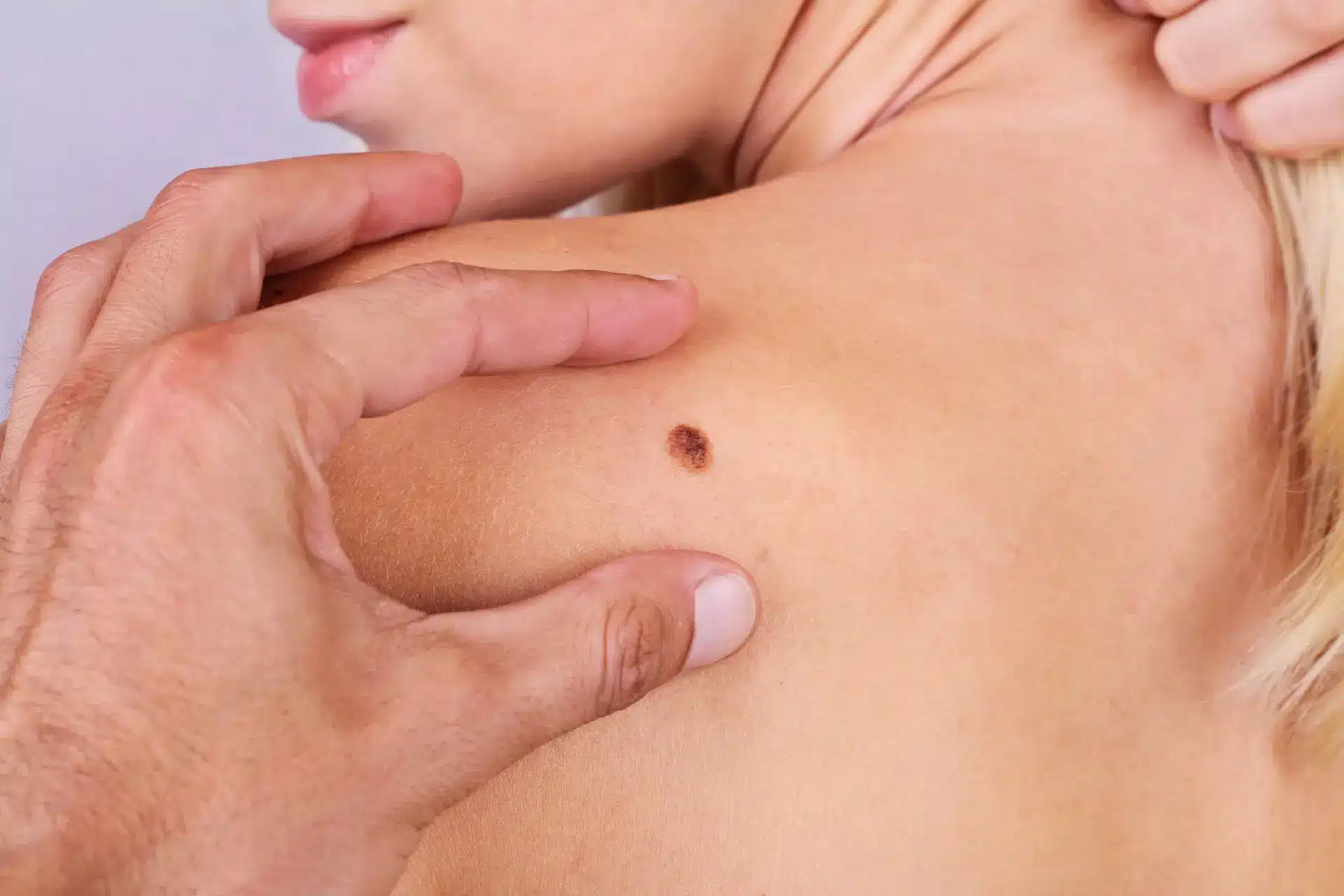
If a mole displays any of these warning signs, book a focused spot check with one of our GPs.
One half of the mole does not match the other half in shape or appearance.
The edges appear ragged, notched, blurred, or irregular rather than smooth and defined.
The pigmentation is not uniform, showing multiple shades of brown, black, red, white, or blue.
The spot measures larger than 6mm across (approximately the size of a pencil eraser).
The mole is changing over time in size, shape, colour, elevation, or developing new symptoms.
Digital Dermoscopy Monitoring — Tracking Doubtful or Equivocal Lesions Over Time
How We Use DermEngine at Our Practice
At Main Street Medical Centre, Dr Nadeesh Seneviratne and Dr Moe Thu use DermEngine — a clinical imaging platform designed for skin cancer surveillance. When a doubtful or equivocal lesion is identified during your appointment, your GP photographs it through their dermatoscope. DermEngine saves each image to the specific body location where the lesion was found, creating a clinical record that can be compared at future visits to detect changes in size, shape, colour, or structure.
DermEngine also includes AI-assisted analysis features that help your GP assess the captured images. However, all clinical decisions — including whether to biopsy, excise, or monitor a lesion — are made by your GP. AI tools support clinical assessment but do not replace your doctor's medical judgement.
Who benefits from digital dermoscopy monitoring?
Your GP may recommend digital dermoscopy monitoring for patients with:
- Doubtful or equivocal lesions that need tracking over time rather than immediate biopsy
- A personal or family history of melanoma
- Previous skin cancer requiring ongoing surveillance
- Lesions in areas that are difficult to self-monitor (for example, on the scalp or back)
- High cumulative sun exposure from outdoor work or recreation on the Fraser Coast
How digital dermoscopy monitoring works
During your appointment, if your GP identifies a lesion that warrants monitoring, they photograph it through their dermatoscope. DermEngine saves the image to the exact body location and provides AI-assisted analysis to support clinical assessment. At subsequent visits, your GP compares the current images with the baseline to track any changes objectively. This approach is particularly valuable for patients in our region where high UV exposure increases the need for ongoing skin surveillance.
Skin check consultations including dermoscopic imaging are bulk billed for eligible Medicare card holders. Eligibility applies.

Introducing OptimaScan 3D Total Body Photography — Advanced Skin Mapping
A Digital Baseline for Your Skin
Main Street Medical Centre offers OptimaScan 3D Total Body Photography (TBP) at our Pialba practice — advanced clinical imaging technology that captures a series of high-resolution photographs of the skin from head to toe, which are reconstructed into a 3D model. OptimaScan creates a comprehensive digital baseline of your skin, supporting our GPs in tracking changes over time with greater precision than visual examination alone.
OptimaScan uses a rotating arm with integrated light panels to capture multi-angle full-body images. The system integrates with DermEngine — the same clinical imaging platform already used by Dr Nadeesh Seneviratne and Dr Moe Thu for digital dermoscopy — so it can be used as part of your existing skin cancer surveillance plan.
Comparing your skin against a baseline
A photographic baseline gives your GP a record of your whole skin at a point in time. At later visits, your GP compares your skin against that record, which can help identify moles that are new, or that have changed in colour, size, shape or position since the last scan. This is particularly relevant for patients with many moles, where changes can be difficult to recall between appointments.
How does OptimaScan compare to DermEngine digital dermoscopy?
Both tools can be used together as part of your surveillance plan. Your GP will discuss what is most appropriate for your individual situation.

What your GP sees in DermEngine. After your OptimaScan scan, your high-resolution images are processed into a 3D body model in DermEngine. Your GP can map individual lesions, compare images between visits, and use AI-assisted analysis to support clinical decision-making.
Who may benefit from OptimaScan 3D Total Body Photography?
Your GP may discuss OptimaScan with you as part of your skin cancer surveillance plan if you fit one or more of the following profiles:
These are the groups Melanoma Institute Australia identifies as likely to benefit from total body photography. Your GP will advise whether it is appropriate for you.
What to expect at an OptimaScan appointment
A trained team member will walk you through the scan from start to finish. Here's what your appointment will look like at our Pialba practice:
Book your scan and GP skin check in one visit
OptimaScan is one of several tools your GP can use for skin cancer surveillance — alongside clinical examination, dermoscopy and DermEngine digital imaging. Your GP can advise whether it's appropriate for your situation. Explore OptimaScan and what to expect →
Fees: OptimaScan is a separate clinical service to a standard skin check. Skin check consultations are bulk billed for eligible Medicare card holders. OptimaScan is a private service: $49 (introductory) until 31 December 2026, then $99 from 1 January 2027. It is not claimable through Medicare and no GST applies. Any associated procedures may incur a separate fee. View fees or call reception on (07) 4325 4000 for an estimate. OptimaScan is available at our Pialba practice — call (07) 4325 4000 to book.
If We Find a Suspicious Spot: What Happens Next?
Many skin changes found during a check are benign. But if a lesion looks suspicious, your GP will explain the findings and recommend the most appropriate next step. This may include one or more of the following:
1) Monitor
If a spot is low-risk but not completely typical, we may recommend a review appointment and/or clinical photography to check for changes over time. This is where digital dermoscopy monitoring or OptimaScan 3D Total Body Photography can be particularly valuable.
2) Biopsy
If a lesion needs confirmation, a biopsy may be recommended. This is a minor procedure where a small sample (or the full lesion) is removed and sent for pathology assessment.
On-site procedures
Where clinically appropriate, our doctors can perform biopsies and excisions on-site in our purpose-built procedure rooms. If a procedure is recommended, we will explain the reason, what to expect, and how to care for the area afterwards.
Results and follow-up
Pathology turnaround times vary. Once results are received, we will contact you with the outcome and next steps. If further treatment is required, we will arrange the most appropriate follow-up appointment.
If a lesion is rapidly changing, bleeding, crusting, painful or not healing, please book the earliest available appointment.
Our Skin Cancer Doctors


Dr Nadeesh Seneviratne
Master of Medicine (Skin Cancer) — University of Queensland
AHPRA: MED0001615316
Dr Nadeesh (MBBS, FRACGP, MMed (Skin Cancer), MSCCA) is an Accredited Skin Cancer Doctor with the Skin Cancer College Australasia. His clinical focus includes advanced dermoscopy, digital lesion monitoring with DermEngine, assessment of suspicious lesions, and minor procedures such as biopsies, excisions and flap repairs where clinically appropriate.
View Full Bio & Verified Credentials →Male GPs for Skin Checks
 Dr Moe ThuFRACGP • Skin Cancer & DermEngine Digital ImagingAHPRA: MED0002032736Dr Yan Paing OoFRACGP • Skin Cancer CareAHPRA: MED0002300657
 Dr Lachlan DavisFRACGP • Skin ChecksAHPRA: MED0002316497
 Dr Haseeb AhmedFRACGP • Skin ChecksAHPRA: MED0001647097
View Dr Moe Thu’s College profile ↗
Female GPs for Skin Checks
We understand that many women prefer a female GP for a full-body skin check. Our female doctors providing skin cancer assessments are trained in dermoscopy and provide thorough, compassionate care. You can also see our female GPs for women's health services during the same visit.
 Dr Zin Zin ThantFRACGP • Dermoscopy & Skin ChecksAHPRA: MED0002351203
 Dr Priyani PereraGP, FRACGP • Dermoscopy & Skin ChecksAHPRA: MED0002424369
All practitioners are registered with AHPRA. Verify on the National Register
Preparing for Your Appointment
To get the most out of your skin check at our Pialba practice, please follow these preparation guidelines:
Frequently Asked Questions
These are the questions our skin cancer clinic in Hervey Bay is asked most often.
How much does a skin cancer check cost in Hervey Bay?
At Main Street Medical Centre, skin check consultations are bulk billed for eligible Medicare card holders. Eligibility applies. Surgical procedures such as biopsies and excisions, and OptimaScan 3D Total Body Photography, incur separate fees — please visit our fees page or speak with reception for details.
Do I need a referral?
No referral is required to book a skin check. You can book directly with one of our GPs through our online booking system or by calling our Pialba practice on (07) 4325 4000.
Are skin check appointments bulk billed?
Skin check consultations at Main Street Medical Centre are bulk billed for eligible Medicare card holders. Eligibility applies. Non-Medicare services may incur a fee.
What is the difference between a spot check and a full body check?
A full body skin check is a head-to-toe examination typically lasting 20–30 minutes. A focused spot check is a shorter appointment (approximately 10 minutes) designed for patients who have noticed a specific mole that concerns them (up to 4 spots).
What is DermEngine and how do you use it?
DermEngine is a clinical imaging platform used by Dr Nadeesh Seneviratne and Dr Moe Thu during skin check appointments. When a doubtful or equivocal lesion is identified, your GP photographs it through their dermatoscope. DermEngine saves the image to the body location where the lesion was found and uses AI-assisted analysis to support clinical assessment. This allows your GP to compare images at future visits and track changes over time. The consultation component is bulk billed for eligible Medicare card holders.
What is OptimaScan 3D Total Body Photography and how is it different from a regular skin check?
OptimaScan 3D Total Body Photography (TBP) is advanced clinical imaging technology that captures a series of high-resolution photographs of the entire skin surface, which are reconstructed into a 3D model. It creates a comprehensive digital baseline that helps your GP identify new or changing lesions over time. A regular skin check is a clinical examination of your skin using dermoscopy. OptimaScan complements that examination by providing an objective digital record of your whole skin to support ongoing surveillance — it does not replace a clinical skin check. OptimaScan is available at our Pialba practice — call (07) 4325 4000 to book. OptimaScan is a private service: $49 (introductory) until 31 December 2026, then $99 from 1 January 2027; it is not claimable through Medicare and no GST applies. Ask your GP whether it is appropriate for your individual situation.
How often should I have a skin cancer check?
It depends on your risk factors and history. If you have a past skin cancer, lots of moles, or high sun exposure (particularly common among outdoor workers and Fraser Coast residents), your GP may recommend more regular skin checks. If you're unsure, book a skin check or speak with your GP about an appropriate schedule.
Do you check scalp, ears, nails and between toes?
A full body skin check is designed to be thorough and may include commonly missed areas such as the scalp, ears, soles of the feet, between toes and nails, where clinically appropriate.
Can I still have a skin check if I have a tan?
Yes, you can still attend a skin check if you have a tan. However, it's important to point out any changing or concerning spots, as tanning can sometimes make subtle changes harder to notice. Your GP will advise if a follow-up visit is needed.
What happens if I need a biopsy or removal?
If a lesion needs further assessment, your GP will explain the findings and may recommend monitoring, dermoscopic imaging, a biopsy, or an excision. Where clinically appropriate, procedures can be performed on-site in our procedure rooms, and the sample is sent for pathology assessment.
Is DermEngine AI used for every skin check?
DermEngine digital imaging is used when closer monitoring is clinically appropriate, such as for patients with doubtful or equivocal lesions, a higher risk history, or lesions that need comparison over time. Dr Nadeesh Seneviratne and Dr Moe Thu use DermEngine at our practice. AI tools support clinical assessment but do not replace your GP's medical judgement.
What should I do if a spot is bleeding, crusting, or not healing?
If a lesion is rapidly changing, bleeding, crusting, painful or not healing, please book the earliest available appointment so it can be assessed by a GP. If symptoms are severe or you feel very unwell, call 000 or go to the nearest Emergency Department.
I work outdoors on the Fraser Coast. How often should I have a skin check?
Outdoor workers in our region accumulate significant UV exposure over time. If you work outdoors regularly, your GP may recommend annual skin checks or more frequent monitoring depending on your risk profile. Digital dermoscopy imaging and OptimaScan 3D Total Body Photography can also help track changes between visits. Book a skin check to discuss a schedule with your GP.
Visit Our Practice for Skin Checks in Pialba
Address: 71 Main Street, Pialba QLD 4655 — close to Hervey Bay Hospital
Phone: (07) 4325 4000
Hours: Monday – Friday, 7:30am – 5:30pm
Parking: Free off-street parking available at the rear of the building, a short drive from the marina precinct (access via driveway off Main Street). Fully wheelchair accessible.
Our practice is located in Pialba and welcomes patients from across the Fraser Coast region:
Other Services at Main Street Medical Centre
In addition to skin checks and skin cancer treatment, our Pialba practice provides a full range of general practice services including chronic disease management, health assessments, women's health, men's health, children's health, immunisations, and ear wax removal. We are a bulk billing practice and have been caring for Fraser Coast families for over 40 years.
About This Page
This information is general in nature and does not replace medical advice. If you have concerns about a skin lesion or mole, please book a skin check with a GP.
Medically reviewed by Dr Nadeesh Seneviratne — MBBS, FRACGP, MMed (Skin Cancer), MSCCA. AHPRA MED0001615316. Reviewed August 2026. Dr Nadeesh has reviewed the clinical content on this page. View his full profile and credentials.

Queensland has very high rates of skin cancer.
Early detection matters. Book your skin check today — bulk billed for eligible Medicare card holders.